
Related News
- 00
0000-00
How Seat Belt Pretensioners and Load Limiters Work Together in a Crash - 00
0000-00
Hot Stamping for BIW: How Die Quenching Controls Strength and Dimensional Accuracy - 00
0000-00
Product Selection Resources for Sourcing: How to Compare Specs and Samples - 00
0000-00
Choosing a Hot Stamped Steel Components Exporter: PPAP and Traceability Checks - 00
0000-00
Sourcing Automotive Body Stampings for OEMs: Tooling, PPAP, and Capacity Checks
Passive Safety Architect
Weekly Insights
Stay ahead with our curated technology reports delivered every Monday.
What Documents Should Accompany an Airbag Module Shipment?





A shipment of airbag modules can look straightforward on a loading plan: sealed cartons, identified part numbers, a booked carrier, and a delivery date. In practice, the paperwork behind those cartons is just as important as the physical packaging. A missing dangerous goods declaration, an outdated safety data sheet, or a traceability mismatch can hold a shipment at a terminal, trigger a customs query, or force an OEM production line to wait.
So, what documents should come with an airbag module shipment? The answer depends on the module’s approved transport classification, the route, the transport mode, the importing country, and the agreement between supplier and customer. Yet most compliant shipments are supported by a core document set: dangerous goods transport documentation, a Safety Data Sheet (SDS), commercial and customs papers, packing information, and product-quality records that preserve traceability from the inflator through final delivery.
For automotive suppliers, logistics coordinators, freight forwarders, and receiving teams, the goal is not simply to “have documents.” It is to ensure that every document describes the same product, quantity, packaging configuration, classification, consignee, and shipment journey.
Begin with the transport classification—not the invoice
An airbag module is a safety-critical assembly. Depending on its design, it may contain an electrically initiated inflator, a pyrotechnic gas generator, or another regulated component. That means its transport status must be verified before any documentation is prepared.
Many airbag modules are shipped under a dangerous goods entry such as UN 3268, Safety devices, electrically initiated, Class 9. However, this must never be assumed from product appearance or a previous shipment. Certain inflators, replacement components, or configurations may be assigned a different UN number, hazard division, packing instruction, or special provision. The legally applicable classification should come from the manufacturer’s approved classification data, test evidence, competent-authority guidance where required, and the rules governing the actual transport mode.
Road, air, sea, and rail transport do not use identical operating rules. ADR may apply to road movements in Europe; IMDG Code requirements govern sea freight; IATA Dangerous Goods Regulations apply to air cargo; and 49 CFR is relevant for domestic transport in the United States. A document package that works for a truck movement may be insufficient for an airfreight booking.
Before release, the shipper should confirm:
- the correct UN number and proper shipping name;
- hazard class or division and any subsidiary risk;
- packing group, if applicable;
- approved packaging instruction and special provisions;
- limited quantity or excepted quantity eligibility, if any;
- net and gross quantities required by the applicable rule set;
- emergency response requirements; and
- whether the carrier imposes additional acceptance conditions.
This classification is the anchor for the rest of the shipment file. If it is wrong, a perfectly prepared commercial invoice will not resolve the problem.
The dangerous goods declaration: the document carriers look for first
Where required by the applicable regulations and transport mode, the shipment must include a dangerous goods declaration (DGD). The form and wording vary by mode. For example, air cargo may require a Shipper’s Declaration for Dangerous Goods, while ocean shipments commonly use a multimodal dangerous goods form or carrier-approved declaration.
The DGD communicates the formal hazard description to the carrier and downstream handlers. It typically identifies the shipper and consignee, UN number, proper shipping name, class or division, quantity and type of packaging, packing instruction, authorizations, and declaration statement. It must be prepared by a trained person and signed or authenticated in the format accepted by the relevant regulations and carrier.
A frequent mistake is treating the DGD as a document created after the freight is packed. In reality, it should be built from controlled master data before dispatch. The quantity shown on the declaration must match the number of units in the packing list and the actual package count presented to the carrier. Small inconsistencies—such as “20 modules” on the invoice and “24 modules” on the DGD—can create a refusal at cargo acceptance.
For road shipments, the transport document may be incorporated into a consignment note or separate dangerous goods transport paper. It should carry all mandatory information for the route, including any tunnel restriction code, special provision, or emergency instruction required under the governing regulation.
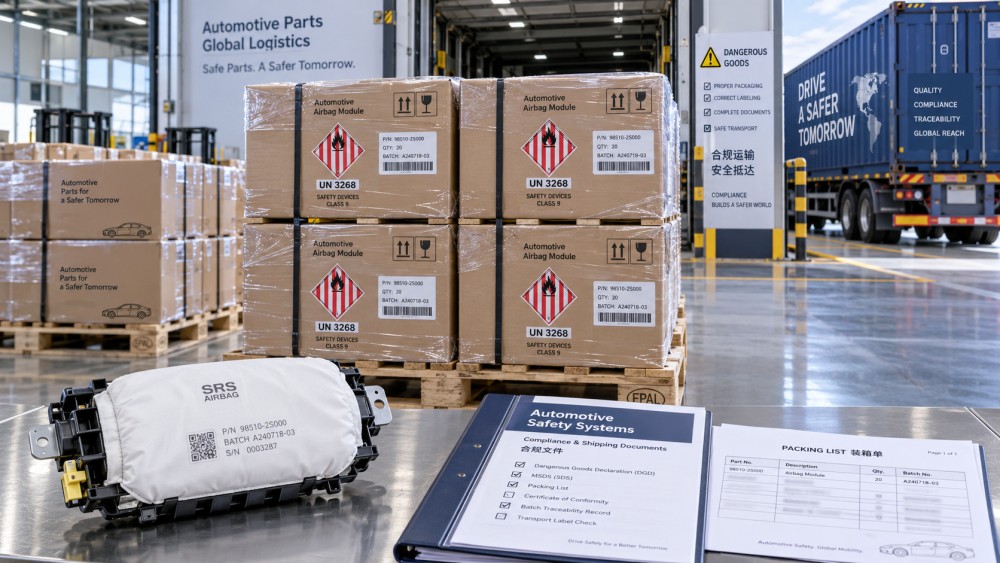
Safety Data Sheet: useful, but not a substitute for transport documentation
A Safety Data Sheet (SDS), sometimes called an MSDS, should normally accompany or be readily available for an airbag module shipment, particularly for international logistics, warehouse handling, customer compliance review, and emergency planning. The SDS gives handlers and receiving teams a broader understanding of product composition, hazards, first-aid measures, firefighting guidance, accidental-release procedures, storage recommendations, and transport information.
However, an SDS does not replace a DGD. The SDS is a hazard communication document; the DGD is a regulated transport declaration. They must be aligned, especially in Section 14 of the SDS, which contains transport information. If the SDS names one UN number while the transport declaration uses another, the shipment should be stopped until the discrepancy is resolved through the product safety or dangerous goods compliance team.
Use the current, market-appropriate version of the SDS. A document written for one jurisdiction may not fully meet the language or chemical-hazard communication requirements of another. Where local rules require translated documentation, provide it before the cargo reaches the destination warehouse—not after a customs official or receiving plant asks for it.
Commercial documents that keep customs and receiving docks moving
Dangerous goods documents address transport risk. Commercial documents explain what is being traded, who owns it, what it is worth, and where it is going. These records are particularly important for cross-border shipments of replacement airbags, service parts, prototype modules, and production quantities moving between supplier plants.
Commercial invoice
The commercial invoice should clearly describe the product in commercially meaningful terms, such as “automotive airbag module,” “driver airbag module,” or “passenger airbag assembly,” alongside internal part numbers and, where appropriate, the dangerous goods description. It should include seller and buyer details, invoice number and date, currency, unit and total value, Incoterms® rule and named place, country of origin where required, and payment terms if relevant.
Do not rely on vague descriptions such as “auto parts” or “safety components.” They invite questions because they do not allow customs authorities or brokers to identify the product reliably. At the same time, avoid using a commercial description that conflicts with the dangerous goods proper shipping name. Both descriptions can coexist: one for customs clarity and one for transport compliance.
Packing list
The packing list is the physical map of the consignment. It should state the number of pallets, cartons, and modules; package dimensions and gross weights; package marks; and the allocation of part numbers or lot numbers by package when necessary. If the shipment uses overpacks, the packing list should make that relationship clear.
Receiving teams often depend on this document to verify an urgent shipment without opening every carton. For airbag assemblies, packaging integrity matters; a well-prepared packing list helps personnel locate a specific lot or part number while minimizing unnecessary handling of regulated goods.
Transport document or bill of lading
Every shipment also needs the relevant carriage document: a CMR consignment note for many road moves, an air waybill for air freight, a sea waybill or bill of lading for ocean freight, or another carrier-issued transport record. The document should identify the shipper, consignee, route, package count, and shipment reference. Dangerous goods details may appear directly on it or be connected through the DGD, depending on the rules and carrier process.
Certificate of origin and customs support records
A certificate of origin may be needed when the importing country, trade agreement, customer, or customs broker requires it. Depending on the trade lane, additional records can include a preferential origin declaration, export declaration, import license support, customs power of attorney, tariff classification record, or broker instruction sheet.
Tariff classification should be assigned carefully. Airbag modules may be classified differently from individual inflators, electronic control units, textile cushions, or seatbelt pretensioners. The correct Harmonized System classification should be validated through the exporter’s customs process rather than copied blindly from a legacy invoice.
Quality and traceability records protect more than the shipment
An airbag module is not an ordinary aftermarket accessory. It is part of the vehicle’s occupant restraint system, designed to perform within milliseconds during a collision. For that reason, OEMs and Tier 1 suppliers commonly require shipment documentation that connects the delivered modules to approved production and release controls.
The exact file varies by customer agreement, but it may include:
- certificate of conformity or certificate of analysis, where contractually required;
- final inspection or release status;
- lot, batch, serial number, date code, or traceability label data;
- purchase order and customer delivery schedule references;
- approved deviation or concession documentation, if applicable;
- change notification records for revised parts or packaging; and
- returnable packaging records or container identification for closed-loop logistics.
Not all of these documents need to travel in the pouch attached to the pallet. Some may be transmitted electronically through a supplier portal, EDI system, quality platform, or secure shipment packet. What matters is that the receiving organization can access the correct version and link it unambiguously to the goods delivered.
Traceability is especially important for recall readiness and containment actions. If a quality concern emerges months later, the supplier should be able to identify which shipment carried which production lot, which inflator configuration was used, and which customer location received it. A mismatch between carton labels and the advance shipping notice can turn a manageable investigation into a broad and costly stock hold.
Air freight, ocean freight, and prototypes need extra attention
Air transport is usually the most restrictive path for airbag modules. Airlines and ground handlers may request advance copies of the DGD, SDS, packaging approval details, photographs of package markings, and confirmation that the shipper has used trained dangerous goods personnel. Booking acceptance should be secured before cargo arrives at the airport.
Ocean shipments require equal care, although the rhythm is different. Carriers often enforce document cut-off times well before vessel departure. The DGD, container packing information, verified gross mass where applicable, and stowage-related data must be submitted correctly and on time. A missed cut-off can leave a container behind even when the product itself is properly packed.
Prototype airbag modules, engineering samples, test units, and returned goods deserve a separate review. They may lack the mature labels, commercial values, customer part records, or transport approvals available for series production. “Sample” is not a transport classification and does not remove dangerous goods obligations. Returns should also be supported by a return authorization, reason-for-return record, and confirmation of whether the module remains intact, deployed, damaged, or suspected of damage. Damaged or defective safety devices may be subject to stricter handling rules.
A practical document-control check before dispatch
Rather than reviewing each paper in isolation, compare the shipment as one connected record. The part number on the invoice should agree with the packing list. Package quantities should agree with the DGD and carrier booking. The consignee’s legal name and address should match customs instructions. Labels and marks on the cartons should match the transport description. The SDS should reflect the current product configuration.
A short pre-dispatch review can prevent many avoidable failures:
- Verify the latest approved dangerous goods classification for the exact module configuration.
- Confirm that packaging, marks, labels, and documentation match the applicable mode rules.
- Check invoice, packing list, DGD, and transport document for identical quantities and consignee data.
- Validate customs classification, declared value, origin, and Incoterms® information.
- Attach or electronically transmit current SDS and customer-required quality records.
- Retain controlled copies according to legal, carrier, customer, and internal retention requirements.
Documentation is part of restraint-system discipline
The best answer to “What documents should come with an airbag module shipment?” is not a single universal checklist. It is a controlled package built around the correct hazardous-material classification and completed with accurate commercial, customs, and traceability information.
For organizations working across global automotive supply chains, documentation deserves the same disciplined attention given to module assembly, inflator handling, packaging validation, and final inspection. The paperwork may not be visible once the vehicle is on the road, but it is essential to getting a critical occupant-protection component safely, legally, and reliably to the place where it is needed.
Related News
- What Should Buyers Review in an Airbag Inflator Supply Agreement?Oct 13, 2026What should buyers check in an airbag inflator supply agreement? Explore essential clauses for safety, traceability, change control, recalls, and supply continuity.
- What Documents Should Accompany an Airbag Module Shipment?Oct 12, 2026What documents should come with an airbag module shipment? Explore DGD, SDS, customs, packing, and traceability records for compliant delivery.
- How to Evaluate an Inflator Systems Factory for OEM Quality, Traceability, and CapacitySep 29, 2026Inflator systems factory evaluation guide: verify OEM quality, traceability, validation discipline, and scalable capacity for safety-critical programs.
- How Can Procurement Teams Evaluate Airbag Modules Wholesale for Vehicle Programs?Sep 05, 2026Airbag modules wholesale guide: evaluate vehicle fit, compliance, traceability, landed cost, and supply resilience to make safer, smarter sourcing decisions.